
The Global Appeal 2026 to End Stigma and Discrimination Against Persons Affected by Leprosy was launched on Jan. 29, 2026, in Brussels, Belgium, at an event co-hosted by Education International and the Sasakawa Leprosy (Hansen’s Disease) Initiative, in partnership with the Damien Foundation. Approximately 80 participants gathered for the event, including persons affected by leprosy, educators, policymakers, health professionals, and civil society representatives.
Education International is a global union federation of 375 member organizations, representing more than 33 million teachers and education support personnel in 180 countries and territories. Dr. Mugwena Maluleke, the federation’s president, declared in his speech: “We are here because we believe education is liberation. We believe education has the transformative power to dismantle misconceptions, challenge prejudice, and build inclusive societies where every student and every educator can thrive.”
Mr. Takashi Kajiwara, Vice President of Education International and President of the Japan Teachers’ Union, spoke of the role of science education in reducing fear of “invisible things,” such as the bacillus that causes leprosy: “If we can scientifically understand the invisible and respond appropriately, we can surely break away from meaningless stigma and discrimination.”
Ms. Maguette Ndiaye, Chairperson of the Oversight Committee of the 3rd Global Forum of People’s Organizations on Hansen’s Disease, asserted, “People affected by leprosy deserve respect, dignity, and the same rights as everyone else. They deserve to go to school, work, and live normally in their communities.”
Ms. Pascale Barnich, General Manager of the Damien Foundation, noted that education can reinforce exclusion, and so it is important to instead develop it as “a key lever for creating societies where differences are a strength and drivers for a more just world.”
Mr. Yohei Sasakawa, WHO Goodwill Ambassador for Leprosy Elimination, emphasized that when barriers to access are removed and teachers share accurate knowledge, “schools can become places where discrimination ends.”
At the conclusion of the ceremony, a declaration expressing the concerns and intentions of participants in Global Appeal 2026 was read from the stage by Ms. Bimla Kujur, a person affected by leprosy from India, together with Dr. Maluleke.
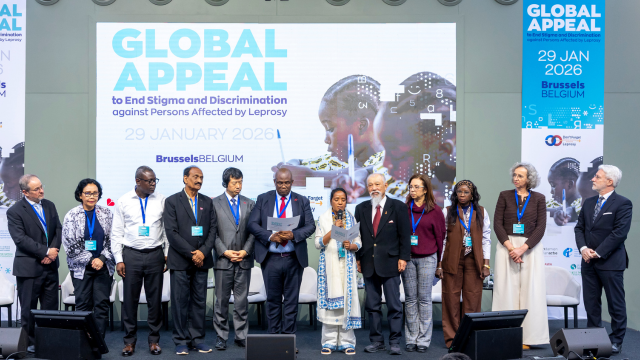
Text of the Global Appeal 2026 declaration
Leprosy, also known as Hansen’s disease, is an infectious bacterial illness that primarily affects the skin and peripheral nerves. Although it is curable, persons affected by leprosy and their families continue to face stigma and discrimination in many parts of the world.
Addressing the misconceptions that perpetuate this injustice requires the transformative power of education. Education plays a crucial role in shaping the values of future generations, and the right to quality education is a precondition for equity, inclusion and social justice.
As the global voice of teachers, Education International is committed to advancing education that fosters critical thinking, challenges prejudices and eliminates all forms of discrimination, within schools and across society.
Equipping teachers and education personnel with accurate knowledge of leprosy and supporting them to share this information with students can help reduce fear and misunderstanding. Such education also fosters empathy and strengthens respect for human rights.
Schools also serve as vital community hubs for health promotion and disease prevention. Promoting awareness and screening can help to identify early signs of leprosy, enabling timely treatment and reducing the risk of disability and stigma.
Education trade unions also have a vital role to play. Through training, campaigns and collaboration with health and education authorities, unions can empower educators to become champions of inclusion and health.
As educators, we will use our collective voice to promote knowledge, empathy and action, working toward a society in which the dignity of all individuals is upheld.