
Takahiro Nanri: As the Director-General of the World Health Organization, Dr. Tedros Adhanom Ghebreyesus, mentioned at the recent World Health Assembly, you are WHO’s longest-serving Goodwill Ambassador. When this role was offered to you 25 years ago, why did you decide to accept it? What did you hope to accomplish?
Yohei Sasakawa: At the time, the general concept of a goodwill ambassador – for any organization – was that of a celebrity who would show up to events when asked. However, I thought that the issues related to leprosy were of such magnitude that I had to get involved in generating solutions. I wanted to establish a new model of a goodwill ambassador who goes out into the field and takes action.
Nanri: Your record over the past 25 years shows that you followed through on being a goodwill ambassador who takes action rather than waiting for invitations. Could you give us an example of a principle you developed for yourself to guide your decisions about which actions to take?
Sasakawa: My guiding principles for this role are often tied to the distinct nature of leprosy as an ancient, highly stigmatized disease. For over 2,000 years, no matter where in the world leprosy has emerged, individuals affected by the disease have been subject to severe prejudice and discrimination. In my view, of all the diseases, only leprosy has such a consistent and deeply rooted stigma, and humanity should not tolerate this situation. However, it is also true that, from a public health perspective, the number of cases is relatively low.
National health ministries naturally focus their attention on diseases with high patient numbers, such as malaria, HIV/AIDS, and tuberculosis. Once I accepted that I would not be able to draw attention and resources to leprosy based on numbers, I had to think about other paths. I realized that focusing on awareness raising among people at the very top of national leadership could lead to changes in budget allocation and new or strengthened programs. This strategic approach became a fundamental part of how I take action as a goodwill ambassador. I always try to meet with each country’s highest-ranking officials as often as possible so that they are thinking about leprosy when making decisions about resources and policies.
Nanri: I have some data here: 2,654 days of activity, 1,812 meetings with ministers and higher-ranking officials, and visits to 127 countries. When you think back over these meetings with top-level officials, is there anything in particular that stands out to you?
Sasakawa: The first thing that comes to mind is the surprise of leaders when I share facts with them about leprosy in their country. Many of them had not given the disease much thought and had underestimated or not known about the number of their country’s residents who are affected. Also, their questions reflect the unfortunate fact that correct knowledge about leprosy is not widespread. I have often received questions like “Isn’t it highly contagious?” One president said to me, “You say you are going to a leprosy hospital tomorrow, but is that really safe? Leprosy scares me. I always tell the driver to keep the windows closed and speed up when my car goes by a leprosy-related hospital.”
I also think about how some top-level officials still use the terms “leper” and “leprosy” when they want to characterize something negatively. This kind of usage comes up in various ways; for example, equating political opponents with leprosy or telling people that they will get leprosy if they do not work hard. Using leprosy as a negative metaphor reinforces prejudice and undermines efforts to eliminate stigma and discrimination against persons affected by leprosy. Whenever I learn that a public figure has used “leper” or “leprosy” in this way, I send an official letter explaining why such usage is discriminatory and asking them to contribute to the fight against stigma by choosing their words more carefully. I have been encouraged that usage of the term “leper,” which is always wrong because it reduces a person to their disease, seems to be declining.
Nanri: I’ve had the opportunity to be present at some of your meetings with leaders of various countries, and each time I noticed that you seem to be very skilled at winning people over. The meetings never feel like just formalities, and some of the meetings result in strong statements of intention or commitment, such as “Let’s eliminate leprosy” or “We should immediately launch leprosy screening efforts.” Because these statements are coming from prime ministers and presidents, they have the potential to set policies and programs in motion. Is there a particular trick to winning people over when you meet with heads of state?
Sasakawa: There’s no secret to it. Rather than trying to win people over, I’ve always placed the highest priority on speaking the truth sincerely and without pretense.
Nanri: I assume that the value that you place on speaking the truth is related to the fact that you have also made a point of visiting the villages and other places where persons affected by leprosy are living. More than anyone else in the world, you have seen a wide variety of leprosy-related situations firsthand. What led you to make these visits part of your work as goodwill ambassador?
Sasakawa: These visits derive from my personal philosophy. I believe that if you go to where the problem is, you will find the solution. I do not agree with staying in an air-conditioned office far away and trying to figure out everything through documents. Especially when it comes to persuading others, I believe there’s a significant difference between an intellectual understanding gained through reading versus the awareness that comes from actually visiting a place and talking directly with the people who are affected. I am sure that some of my ability to persuade comes from leaders being able to feel that I have directly witnessed certain situations.
Nanri: You’ve seen many different locations where there are cases of leprosy over the years. Is there one in particular that stands out in your memory?
Sasakawa: No, one does not stand out to me more than another. Each person affected by leprosy has gone through experiences that the rest of us can’t even begin to imagine. Leprosy is just a disease. The kind of suffering that I see because of the stigma should not be happening.
Nanri: Considering all of the various problems associated with leprosy, how would you characterize the current state of humanity’s fight against the disease?
Sasakawa: To be honest, we’re only halfway there. The data does not accurately reflect the number of people who have the disease. Stigma and discrimination continue. For a while, I thought that if I worked hard enough, leprosy and issues related to the disease could be ended within my lifetime. Now I see that this might not happen. I need to count on other people to carry on the work and achieve the goal.
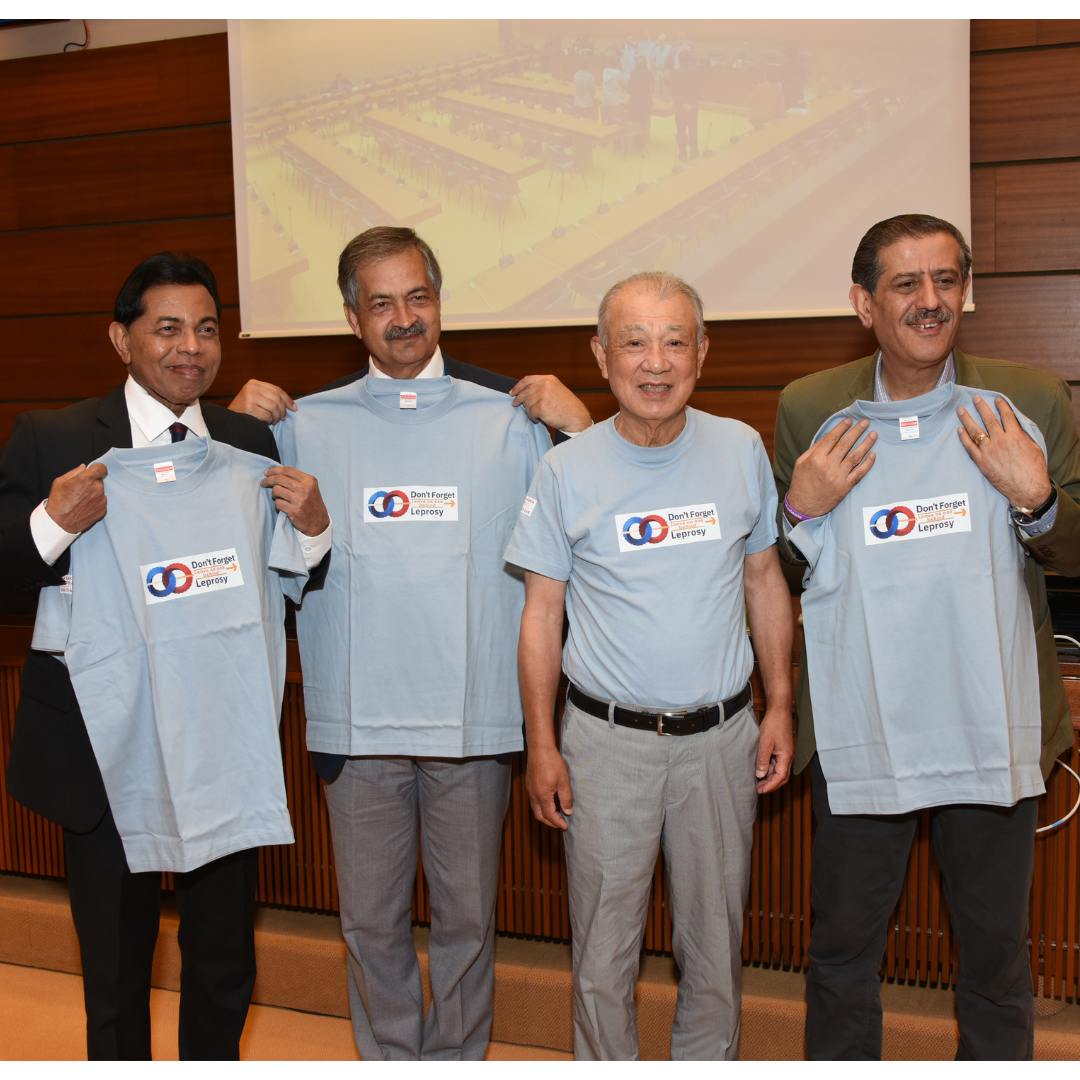
Nanri: Related to involving others, during the COVID-19 pandemic, you launched the Don’t Forget Leprosy campaign, and this year you are continuing the campaign with the additional slogan “The last mile starts now.” This idea of the “the last mile” has long been important to you. Could you explain what you mean by this and why it is especially relevant now?
Sasakawa: I use the phrase “the last mile” because it is somewhat poetic and easy to remember in English, but I am actually thinking about a Japanese proverb that measures distance in a traditional unit called ri (hyaku-ri yuku mono wa kujūku-ri o motte nakaba to su). A relatively literal translation would be “One who would go 100 ri is halfway at the 99th.” The point is about the amount of energy that it takes to complete the last part of a journey. Instead of saying to oneself “I’m almost there,” it is important to maintain focus and keep going as if one were only halfway. So I hope that people hearing “The last mile starts now” do not get caught up on a certain meaning of “last mile” and instead think about it as a reminder that precisely now, when the number of cases has dropped and we feel the end is in sight, we need to keep up our energy, stay committed, and work together so that we actually reach the goal.
Nanri: Finally, from the perspective of the WHO Goodwill Ambassador for Leprosy Elimination, what is one thing that you would like everyone to know about leprosy?
Sasakawa: Despite all of my efforts to raise awareness over the past 25 years, I am still finding that most people do not have an accurate understanding of leprosy. We need to spread correct information so that people know that this is not a scary disease. To help people understand, I often point out that I have touched thousands of patients with my bare hands and never acquired leprosy. This is a way to share the fact that leprosy is one of the least contagious infectious diseases. We need to keep finding ways to share facts in simple ways to reduce fear.