
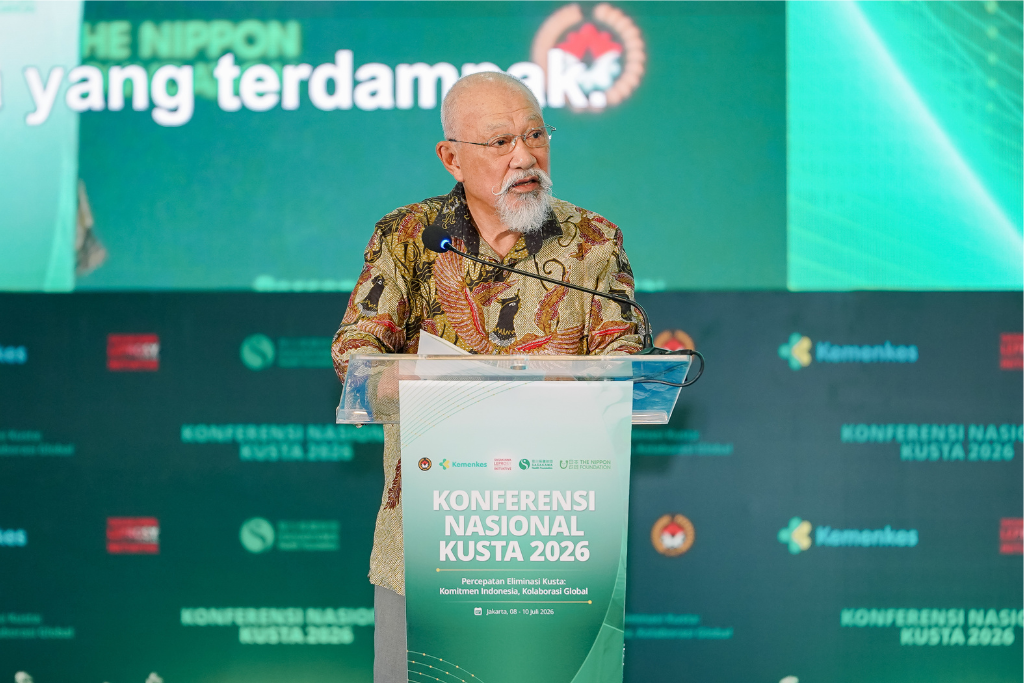
From July 8 to 10, the Republic of Indonesia and the Sasakawa Leprosy (Hansen’s Disease) Initiative co-hosted the country’s first national conference on leprosy. The event brought together Coordinating Minister for Human Development and Cultural Affairs Pratikno; Minister of Home Affairs Tito Karnavian; Minister of Health Budi Gunadi Sadikin; government representatives from all 38 provinces; health officials; and persons affected by leprosy. The final day gathered over 400 participants, including researchers and representatives from international and local non-governmental organizations.
Government representatives from each of the 38 provinces pledged to strengthen efforts to combat leprosy, and a plan was announced to establish an inter-ministerial task force. Minister of Health Budi declared that Indonesia will aim to increase the number of registered new cases per year from the current number of around 14,000 to 37,000. It is assumed that these additional cases already exist, but have not yet been diagnosed. Setting a target number is expected to strengthen early detection efforts.
As the WHO Goodwill Ambassador for Leprosy Elimination, I have consistently conveyed the message that an increase in the number of new cases is proof that leprosy control measures are being implemented effectively, but until now there has never been an instance where a minister in charge of a nation’s health policy has set specific numerical targets and encouraged active detection of new cases. If Indonesia – which has the third-highest number of new cases in the world – can demonstrate a pioneering model for early detection and early treatment, the ripple effect should greatly contribute to accelerating efforts in other countries as well.





-1.png)
.jpg)