

Dr. Venkata Ranganadha Rao Pemmaraju
Program Advisor for Medical Issues
Sasakawa Health Foundation
As an epidemiologist and Acting Team Leader of WHO’s Global Leprosy Programme, Dr. Pemmaraju contributed to the development of effective global strategies for elimination of leprosy. He joined the Sasakawa Health Foundation as a program advisor for medical issues in July 2023.
Leprosy still exists: the data from 188 countries published by the World Health Organization (WHO) as the Global Leprosy Update 2024 confirms it. As per the update, 172,717 new leprosy cases were reported from 133 countries. WHO listed 23 countries as global priority countries, which together accounted for 96% (165,578) of new cases detected during the year.
WHO’s South-East Asia Region contributed 72% of the new cases globally. The high prevalence of leprosy justifies continued positioning of WHO Global Leprosy Programme within the Regional Office for South-East Asia (SEARO), rather than at WHO headquarters in Geneva.
New case detection
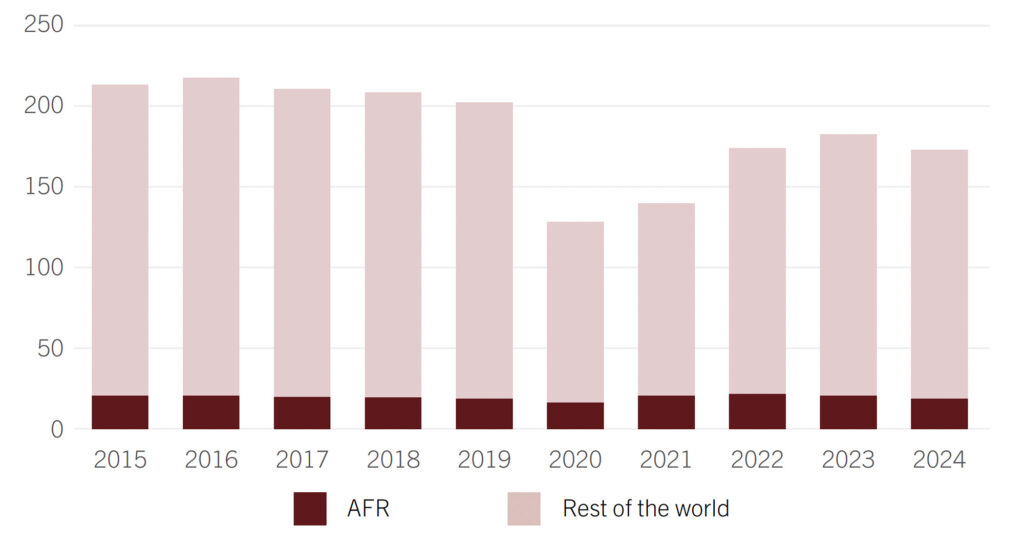
Though multidrug therapy (MDT) has reduced prevalence considerably, new cases continue to occur in most leprosy-endemic countries. Over the past nine years, the number of new cases detected per year has declined from 214,339 in 2015 to 172,717 in 2024. Correspondingly, the global new case detection rate decreased from 29.1 per million population in 2015 to 21.11 in 2024.
The number of new cases detected in WHO’s African Region (AFR) remained at more or less the same level that it has been at since 2015. In contrast, there has been an obvious reduction in the number of new cases in the rest of the world. Figure 1 illustrates the difference between the trend in AFR compared to that of the rest of the world. Brazil, India, and Indonesia collectively continue to account for nearly 80% of the world’s new cases.
Autochthonous cases in European Region
The European Region (EUR) has been low endemic for the past century. About seven years ago, countries began distinguishing between cases acquired locally (autochthonous) and cases imported from elsewhere (non-autochthonous), as part of improved disease tracking systems. In 2024, of the 79 new cases reported in EUR, 14 were locally acquired (6 in Türkiye, 3 in Uzbekistan, 2 in Ukraine, 2 in France, and 1 in Portugal). The occurrence of these autochthonous cases in a low-endemic region needs to be respected with Critical Instance Investigation¹ to understand the possible sources of infection and other factors pertaining to transmission. Post-exposure prophylaxis by tracing contacts for each of those patients will help minimize further transmission in the community.
Grade 2 disabilities (G2D)
According to the Global Leprosy Update, 9,157 new cases with grade 2 disability (G2D) were reported in 2024, corresponding to a G2D case detection rate of 1.1 per million population. This continues a downward trend in the number of new cases with G2D observed over the past decade. Between 2015 (14,385 cases) and 2024, the number of new G2D cases fell by approximately 36%. At the higher-burden end of the spectrum, two countries reported more than 1,000 new G2D cases and 13 countries reported more than 100. Because the occurrence of G2D in new cases reflects delayed diagnosis, countries are encouraged to strengthen and expand early detection activities.
Leprosy in children (under age 15)
The incidence of a new child case reflects active transmission in the community. Globally 9,397 new child cases were reported with a corresponding new child case detection rate of 4.7 per million children. The number of child cases has nearly halved in ten years.
While there is a general decrease in WHO Regions overall, the Western Pacific Region (WPR) reported 96 more new child cases than last year, with increases notable in Kiribati, the Philippines, Papua New Guinea, Solomon Islands, Micronesia, and Vanuatu.
New cases with G2D among children reflect delay in detection in addition to continued transmission. In 2024, 289 new child cases were diagnosed with G2D, of which 115 (40%) were in AFR. Trends of new child cases with G2D from 2016–2024 are presented in Figure 2. It is a major concern that new cases with G2D among children were detected in 2024 despite the target of “zero child cases with G2D by 2020” set by the WHO Global Leprosy Strategy 2016–2020².
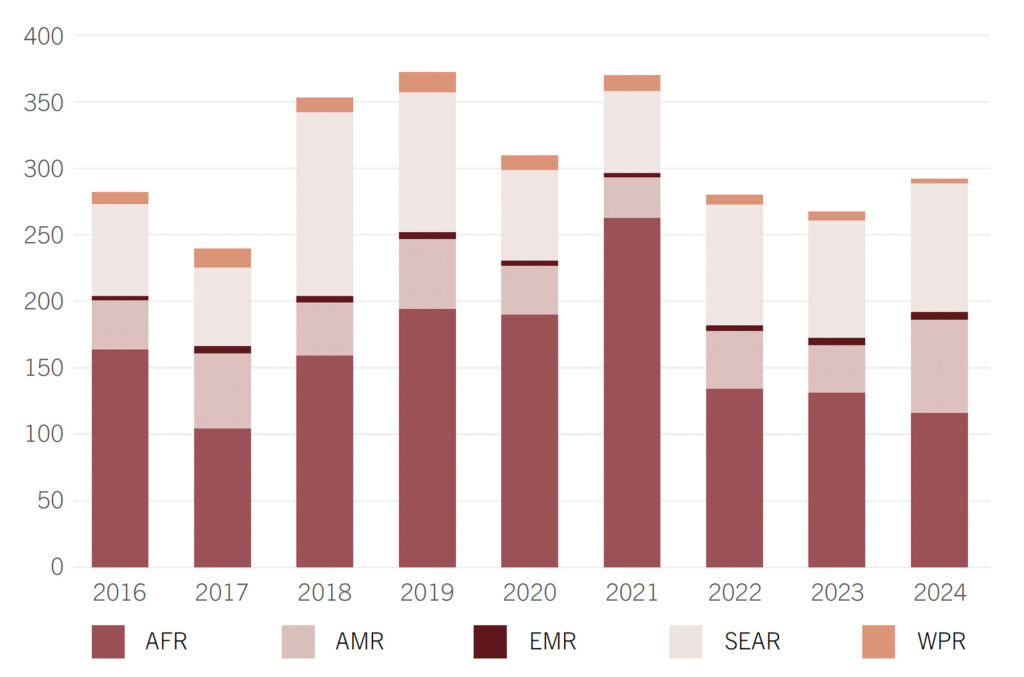
Reaching zero disabilities initially among children and further among all populations should be factored in as mandatory milestones in national strategic plans for leprosy.
Immunological reactions (lepra reactions)
Immunological reactions, called lepra reactions in the medical field, can suddenly worsen symptoms and may cause serious disabilities or life-threatening complications. In 2024, there were 20,341 reported cases of lepra reactions, though this figure primarily reflects reactions documented at the time of initial diagnosis and the true burden is likely higher, as many patients develop reactions after starting treatment. Management of lepra reactions remains an enigma to frontline health staff. An effective referral system and a standardized protocol for management of reactions should be developed to prevent disabilities and improve health.
Post-exposure prophylaxis (PEP)
The case detection details from contact examination were found encouraging and can be recommended to countries where it is not practiced. Coverage of contact examination needs improvement (from 59% to 90%). Single dose rifampicin (SDR) was administered to 1.7 million people in 2024 as reported from 37 countries, which indicates considerable progress in implementation.
Stigma and discrimination
Six countries reported that 81 discriminatory laws are still active in 2024. WHO is advised to make a comprehensive inventory involving relevant stakeholders like persons affected and civil society. Information about instances of discrimination was not reported. Considering the need for understanding prevailing stigma, it will be useful to consider using a systematically developed diagnostic device.
Critical issues requiring action
Persistent global endemicity: 133 countries report one or more new cases of leprosy. Sustained and intensified case detection campaigns are essential to break the cycle of transmission.
Stagnant case detection: New case detection continues at relatively the same level, with 172,717 cases reported in 2024. Improved case-finding campaigns and preventive initiatives are needed to accelerate the decline.
Concentration of burden: The 23 global priority countries account for 96% of new cases. National and international resources must be strategically concentrated in these high-burden settings.
Delayed diagnosis in children: Nearly 300 children are diagnosed with visible impairments (grade 2 disability, G2D) annually. Early detection systems must be strengthened.
Management of lepra reactions: Over 20,000 cases of lepra reactions were reported in 2024. Better treatment protocols to manage severe reactions must be prioritized to improve quality of care.
Discrimination and legislative reform: At least 81 discriminatory laws reported to WHO remain in force globally. Repealing all laws that allow discrimination should be brought back as a target in national strategic plans.
Underreporting of stigma and discrimination: Instances of discrimination are not getting registered and addressed. Systematic tools and mechanisms must be developed to diagnose and monitor discrimination in health systems and communities.
¹ The term “Critical Instance Investigation” (CII) in public health refers to a specific, intensive case investigation protocol used primarily in national and subnational leprosy control programs, particularly in areas nearing or having achieved disease elimination (defined as a prevalence rate of less than one case per 10,000 population).
² World Health Organization, Global Leprosy Strategy 2016–2020: Accelerating towards a Leprosy-Free World (New Delhi: World Health Organization, Regional Office for South-East Asia, 2016), https://www.who.int/publications/i/item/9789290225096.